
New ‘Off-Facebook Activity Tool’ lets users control data collected by websites

Off-Facebook Activity lets users see a summary of the apps and websites that send Facebook information about their activity.

Over the past decade when we saw Facebook shifting from just another social network, it greatly expanded its feature range. With this, tools such as “Facebook Login” and “Facebook Pixel” were launched.
In the case of the former, website owners can record your information when you use Facebook to log in onto their sites and then use this to display targeted ads. For the latter, it is a tool that allows website owners to integrate a piece of code which can be used to track site visitors and their actions. Later on, the data gained by tracking those users can be utilized for better ad targeting.
With this, in a bid to increase transparency, Facebook has launched yet another feature working with its privacy experts. Dubbed as “Off-Facebook Activity”, it comes as a fulfillment of the announcement CEO Mark Zuckerberg made last year along the lines of,
“Once we roll out this update, you’ll be able to see information about the apps and websites you’ve interacted with, and you’ll be able to clear this information from your account.”
What this means is that you can now view all the data that third-party app and websites have been sharing with Facebook and not only anonymize it but also turn off future data collection activity. For example, if I find Amazon collecting my “likes & shares” for some reason, I could restrict that if I wanted to with this new tool.
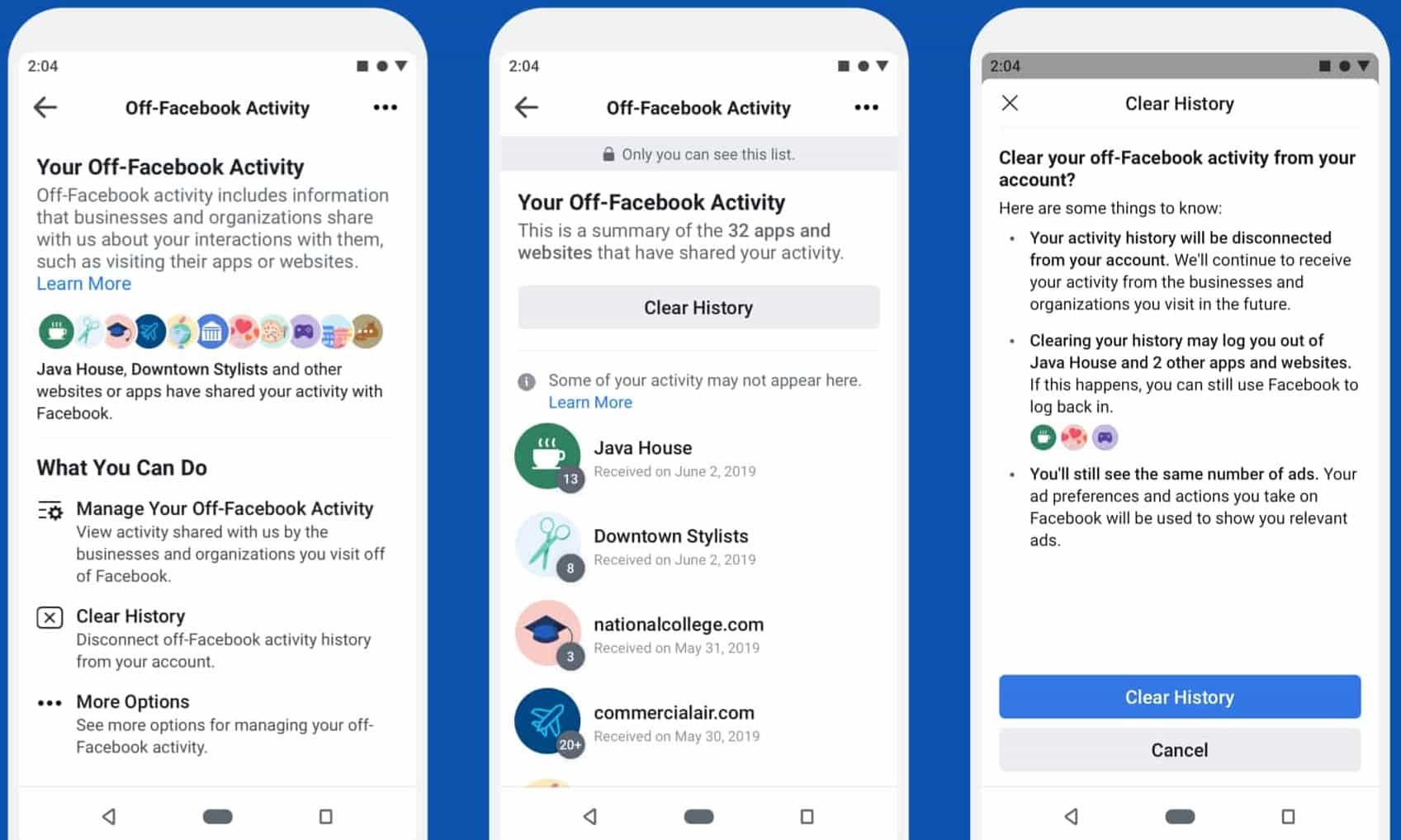
Off-Facebook Activity - Anonymizing your data
Screenshot: Facebook
However, as evident from the screenshots above, a downside is that if you choose to disconnect the data-sharing capability with a specific website or app, you’ll also be instantaneously logged out from that respective app or site. Moreover, it is to be clarified that the data is not deleted with the “Clear History” button, rather your profile is disassociated with it removing any link that could be used to identify that it is yours.
Regardless, the recent announcement will indeed help Facebook move towards the good books of its security-conscious users and earn their trust, particularly since the Cambridge Analytica scandal.
Currently, this feature has been rolled out in a handful of countries only: Ireland, South Korea, and Spain. It will be available in other countries in the coming months as Facebook wants to make the transition slowly in order to ensure that it is working reliably once active.

Comments

Popular posts from this blog

List Of Sql Infected Sites-HACKEREAD

SQL injection  is a  code injection  technique, used to  attack  data-driven applications, in which malicious  SQL  statements are inserted into an entry field for execution (e.g. to dump the database contents to the attacker).  SQL injection must exploit a  security vulnerability  in an application's software, for example, when user input is either incorrectly filtered for  string literal   escape characters  embedded in SQL statements or user input is not  strongly typed  and unexpectedly executed. SQL injection is mostly known as an attack  vector  for websites but can be used to attack any type of SQL database. List of SQL Infected sites:  http://www.genhound.co.uk/source.php?id=477 http://www.lcoastpress.com/journal.php?id=8 http://www.travellers-tales.co.uk/travelJournal.php?id=42 http://www.arrowvalves.co.uk/content.php?id=8 http://www.reaplasrack.co.uk/content.php?id=129 http://www.arrowval...

Google dork list for XSS (Cross- site scripting)-2020

GOOGLE DORK LIST FOR Cross-site scripting -2020 Google Dorks  its also known as google query ,List “Google Hacking” is mainly referred to pull the sensitive information from Google using advanced search terms that help users to search the index of a specific website, specific file type and some interesting information from unsecured Websites. Google Dorks list  2020 can uncover some incredible information such as email addresses and lists, login credentials, sensitive files, website vulnerabilities, and even financial information (e.g. payment card data). Here you can see an example to understand how  Google Darks   password  used by hackers to gain sensitive information from specific websites. You can also use for Exploit DB site to give you according to you Search state. https://www.exploit-db.com/ “ inurl: domain/ ” “ additional dorks A hacker would simply use in the desired parameters as follows: inurl = the URL of a site you want...

Popular Android Zombie game phish users to steal Gmail credentials

The app made its way to Google Play Store was also found phishing users for Facebook credentials. Scary Granny ZOMBY Mod: The Horror Game 2019 is the latest game on Google Play Store that is condemned by the digital security fraternity for sneakily stealing personal data from unsuspecting users. The game, which has been downloaded for over 50,000 times, was available for Android devices making Android users its primary target. The malicious app attempts to collect sensitive information such as Facebook and Gmail login credentials. The malicious activities of Scary Granny ZOMBY Mod were detected by the mobile security firm Wandera. The company found out that the app asks users to enter their Gmail or other Google account credentials, which are then used for collecting private data of the user by hijacking the account –  All of this happens, unsurprisingly, without alerting the user. Gmail phishing page on the supposed gaming app (Screenshot: Wandera) Rese...